Picture a stabilized camera gimbal mounted on a moving vehicle, continuously panning and tilting to track a subject while transmitting live video footage back to an operator. Every rotation, every vibration from the road, and every sudden jolt puts stress on the internal wiring connecting the rotating camera head to the stationary base.
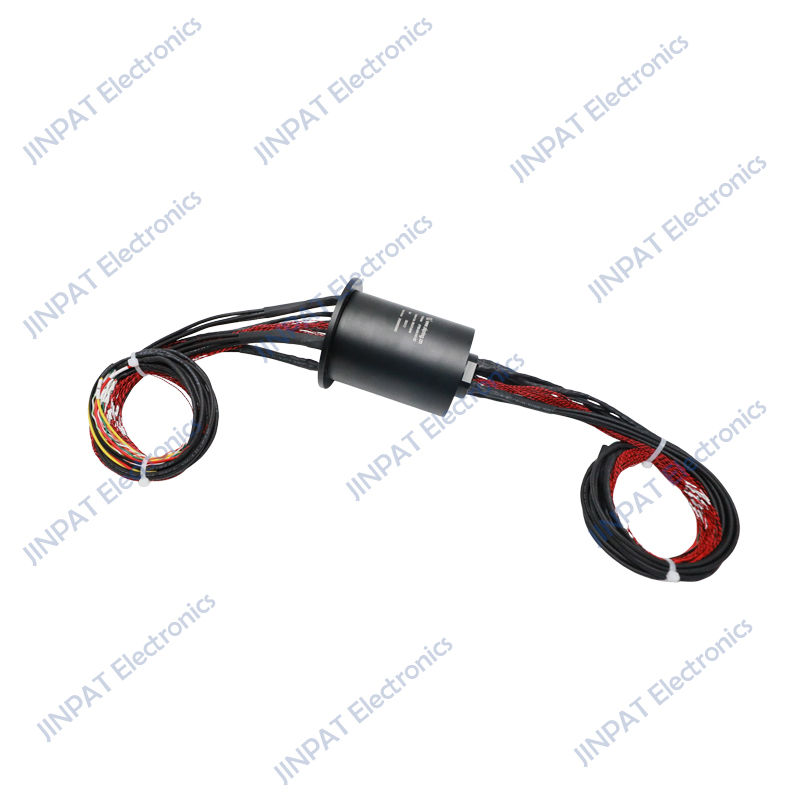
This is precisely the operating environment the JINPAT LPT hollow shaft slip ring was built for. Its hollow bore design allows internal cabling—power lines, camera signal cables, or stabilization control wiring—to pass directly through the center of the rotating shaft, keeping the gimbal housing compact and avoiding the tangling issues common with externally routed cables.
Beyond mechanical design, the JINPAT LPT hollow shaft slip ring integrates multiple signal channels together with an Ethernet path, enabling the gimbal system to simultaneously handle motor control signals, sensor feedback, and network-based video streaming—all through one rotary interface rather than several separate connectors.
What sets the JINPAT LPT hollow shaft slip ring apart in gimbal applications specifically is its resistance to vibration and shock. Gimbal platforms rarely operate in still conditions; whether mounted on a drone experiencing flight vibration, a ground vehicle traveling over uneven terrain, or a robotic arm making rapid directional changes, the slip ring must maintain stable contact and uninterrupted signal flow throughout.
This combination—hollow shaft pass-through, integrated multi-signal and Ethernet transmission, and vibration-resistant construction—makes the LPT series a practical fit for aerial photography gimbals, vehicle-mounted surveillance systems, and industrial pan-tilt units where reliability under motion is non-negotiable.